

Raster Mapper#
The raster mapper weitsicht.MappingRaster uses a raster DEM/DSM to:
sample heights for given ground coordinates, and
intersect rays (e.g. from a perspective image) with the raster surface to obtain 3D hit points.
Internally it uses rasterio for IO and sampling.
Memory and IO behavior#
By default, MappingRaster does not load the raster into memory. It keeps a
rasterio.DatasetReader open and reads only the height values needed at runtime (e.g. via sampling).
Only when you explicitly enable window/full preloading (preload_full_raster, preload_window) or call
load_window() is raster data read into a numpy array and stored in
georef_array (a MappingGeorefArray instance).
When georef_array is present, map_coordinates_from_rays()
and map_heights_from_coordinates() automatically delegate to that in-memory backend.
This avoids disk IO and uses the (more accurate) bilinear-patch ray intersection model implemented by
MappingGeorefArray.
When to use this mapper#
Use MappingRaster when you have a DEM/DSM and want terrain-aware pixel-to-ground mapping:
drone imagery over terrain
wildlife surveys over variable relief
any use-case where a flat plane is not a good approximation
Initialization requirements#
You must provide a readable raster file path. Common configuration parameters:
raster_path: path to a file supported by rasterio (GeoTIFF is typical).index_band: required if the dataset has more than one band (bands start at 1).crs: optional override of the raster CRS.force_no_crs: force CRS toNone(advanced; only safe if you know everything is in the same CRS).preload_full_raster/preload_window: optional in-memory loading for faster repeated operations.
If a mapper CRS is set (either from the raster metadata or via crs=...), it must be 3D (have a Z axis).
CRS and projections#
The raster itself can be stored in many different coordinate systems. Typical examples are:
projected CRSs in meters (UTM, Lambert Conformal Conic, national grids, …),
geographic (ellipsoidal) CRSs in degrees (lon/lat) with a height axis.
weitsicht can work across different CRSs by transforming points between the input CRS (crs_s) and the mapper CRS.
See Coordinate Transformations for details.
Important
Ray/line intersection math assumes an approximately Euclidean coordinate system with linear units in XY. For reliable ray intersections, provide rays in a projected (meter-based) 3D CRS where Z represents height.
Do not run ray intersections directly in lon/lat degrees; if your poses are in geographic coordinates, transform them to a suitable projected CRS first, and transform results back afterwards if needed.
Core methods#
Height sampling (coordinates → heights)#
map_heights_from_coordinates(...) takes (x, y) (or (x, y, z)) coordinates and returns 3D coordinates with an
interpolated height from the raster.
Notes:
bilinear interpolation is used (a 2×2 window around the target pixel),
coordinates outside the raster are masked and return
Issue.OUTSIDE_RASTER.
Ray intersections (rays → surface hits)#
map_coordinates_from_rays(...) intersects rays with the raster surface and returns 3D hit points.
High-level behavior:
rays are tested per input element,
rays that never intersect the raster surface in a valid direction are masked and may add
Issue.WRONG_DIRECTION,rays leaving the raster extent are masked and add
Issue.OUTSIDE_RASTER.rays touching raster no-data cells (holes) are masked and may add
Issue.RASTER_NO_DATA,rays where the iterative intersection does not converge are masked and may add
Issue.MAX_ITTERATION.
How ray intersections work (iterative ray–plane intersection)#
The disk-backed raster mapper uses an iterative approach to find an intersection between a 3D ray and a raster height field. Conceptually, the raster is treated as a function:
and for each ray the mapper searches for a parameter \(t\) such that:
Implementation idea (in words):
Choose an initial plane height guess \(z_i\) between the camera height and the raster height below the ray start.
Intersect the ray with the horizontal plane \(z = z_i\) (ray–plane intersection).
Transform that intersection point into the raster CRS and sample the raster height at its \((x, y)\).
Transform the sampled height back to the source CRS (important when vertical transformations are involved).
Update the plane height guess toward the sampled height (a damped update is used to reduce oscillation) and repeat.
Stopping criteria:
the height difference between the current plane guess and the sampled raster height falls below ~2 cm, or
a maximum iteration count is reached (then the ray is treated as not intersecting reliably).
The following figure shows the idea in a vertical profile (X–Z slice): each iteration intersects the ray with a horizontal plane \(z = z_i\), samples the raster height at the resulting \((x, y)\) location, and updates the next plane height guess.
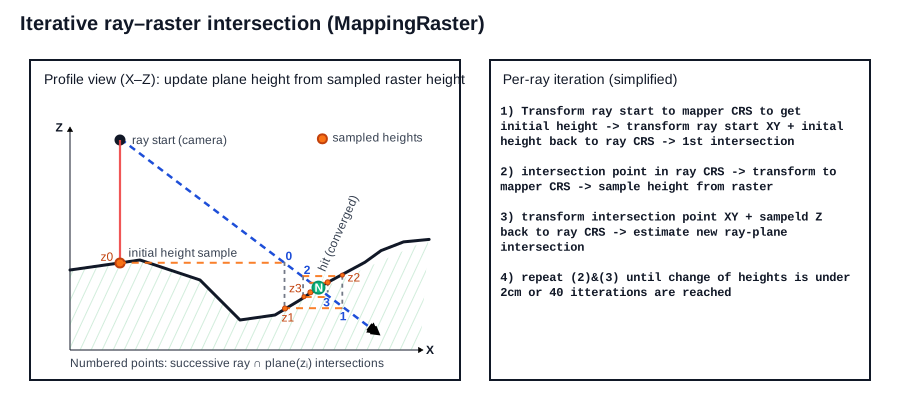
Iterative ray–raster intersection as used by weitsicht.MappingRaster.#
Note
This approach keeps the ray direction vector in the source CRS and transforms points into the raster CRS for sampling. This avoids transforming direction vectors through potentially non-linear CRS operations, but it requires multiple point transformations and raster samples per ray.
In-memory window (optional)#
If you repeatedly intersect many rays within a limited raster extent, you can load a raster subset into memory.
MappingRaster.load_window(...) populates mapper.georef_array (and also returns it) as a
MappingGeorefArray instance. Once loaded, MappingRaster.map_* methods automatically use this
in-memory backend.
Convenience helpers:
mapper.backendreturns the active backend (MappingGeorefArrayif loaded, otherwiseMappingRaster).mapper.georef_mapperreturns the cached backend or raises if no window/full raster is loaded.
Important
If you cache only a window, mapping operations are limited to that cached extent. Points/rays outside the cached window
will be reported as Issue.OUTSIDE_RASTER.
For details about the in-memory backend (including its bilinear patch ray intersection model), see GeorefArray Mapper.
Minimal example#
import numpy as np
from pyproj import CRS
from weitsicht import MappingRaster

mapper = MappingRaster(
    raster_path="dem.tif",
    crs=CRS.from_epsg(32633),  # optional override; otherwise read from the file
    index_band=1,              # required if the raster has multiple bands
)

# Height sampling
xy = np.array([[601932.0, 5340348.0], [601948.0, 5340359.0]])
res_h = mapper.map_heights_from_coordinates(xy, crs_s=mapper.crs)

# Ray intersections (origins + direction vectors must be in the same source CRS)
# hits = mapper.map_coordinates_from_rays(ray_vectors, ray_starts, crs_s=image_crs)