

Mesh Mapper#
Note
Currently only the closest intersection is returned by map_coordinates_from_rays().
Warning
Only cartesian-like coordinate systems (ECEF, UTM, …) should be used for the mapper CRS.
The mesh mapper weitsicht.MappingTrimesh wraps a triangular surface mesh and performs ray/triangle
intersection using trimesh. It is designed for two common geospatial tasks:
sampling surface heights for given (x, y) locations by casting vertical rays downwards
intersecting camera (or LiDAR) rays with the mesh to obtain 3D hit points
Trimesh handles the heavy lifting via trimesh.ray, which builds a BVH (bounding volume hierarchy) to accelerate
intersection queries.
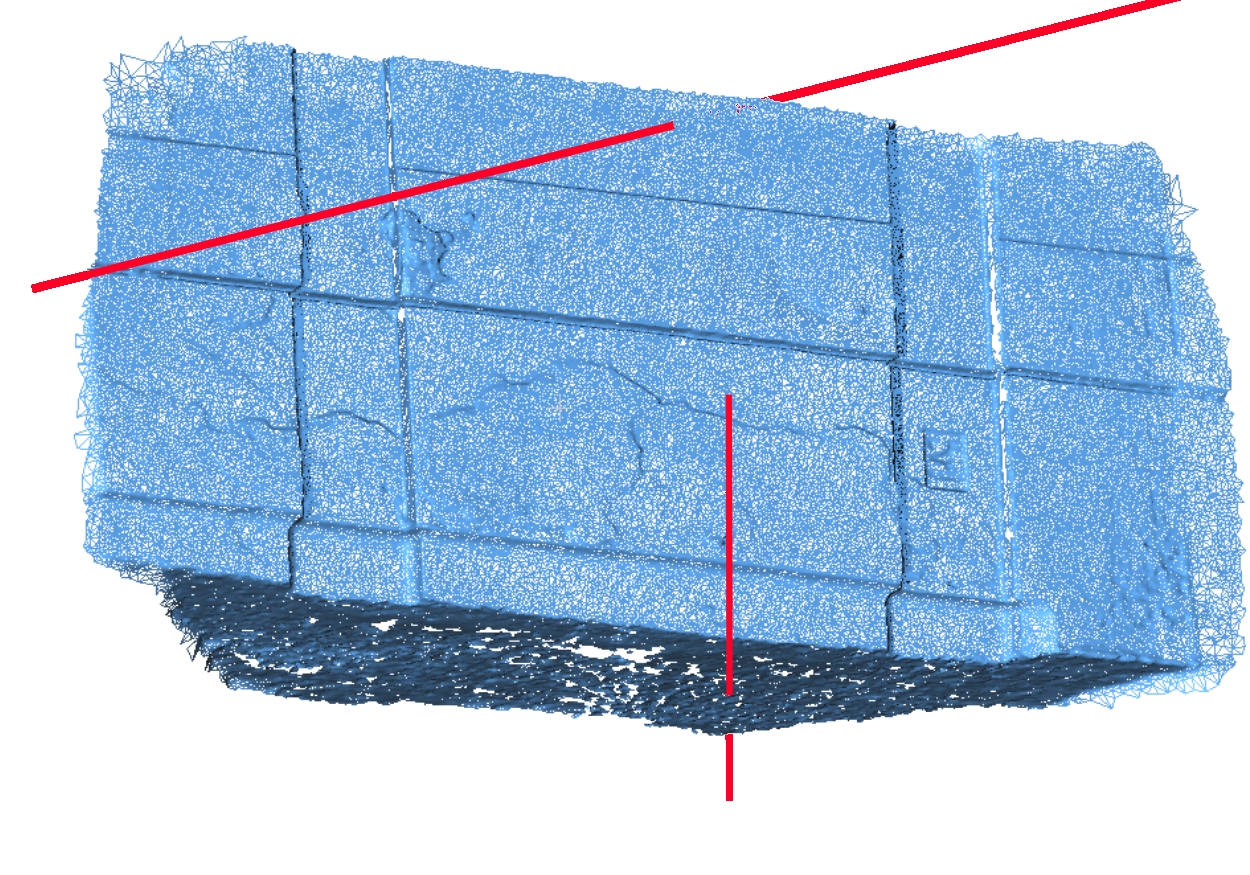
Ray/mesh intersection used for height sampling and back-projection.#
Transformation strategy#
The mesh itself is not reprojected. Instead, rays are transformed into the mesh CRS for intersection.
Implementation detail:
weitsicht transforms multiple points along each ray (at fixed distances) and reconstructs a robust direction vector
in the target CRS. This avoids directly transforming a direction vector through potentially non-linear CRS operations.
Typical workflow#
Initialize the mapper from a mesh file path.
(Optional) specify
crsand/orcoordinate_shiftif the mesh uses a local coordinate origin.Use either:
map_heights_from_coordinates(...)for (x, y) → height sampling, ormap_coordinates_from_rays(...)for ray intersections.
Performance notes#
For dense ray batches, trimesh may use accelerated backends when installed (platform-dependent).
If the mesh has holes, rays can pass without intersections; these rays are returned as invalid.
Minimal example#
import numpy as np
from pyproj import CRS
from weitsicht import MappingTrimesh

mapper = MappingTrimesh(mesh_path="terrain.ply", crs=CRS.from_epsg(32633))

# Height lookup at ground coordinates
xy = np.array([[10.0, 12.5], [15.0, 18.0]])
res_h = mapper.map_heights_from_coordinates(xy, crs_s=mapper.crs)

# Ray intersections (origins + vectors must be in the same source CRS)
# hits = mapper.map_coordinates_from_rays(ray_vectors, ray_starts, crs_s=image_crs)